The Spore You Know

It’s our first fungi workshop and the weather should be perfect: sunny skies and a high of 69 degrees!
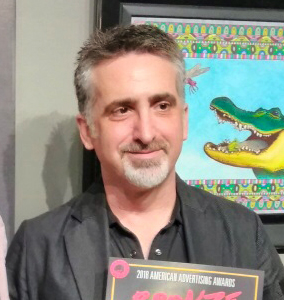
Todd Maggio

That’s this coming Saturday, Oct. 3, 9 a.m. – 3 p.m. Todd Maggio will instruct, assisted by Dr. Laura Sims. Todd is a fungi aficionado and expert, but his day job is graphic design–both doing and teaching at La Tech. Dr. Sims is a member of the La Tech forestry faculty.

We will spend the day in Ruston, gathering at Ruston Artisans at 203 W. Alabama Ave. for what Todd promises will be a short period of instruction. At mid-morning we will adjourn to one of the various parks in and around Ruston.

The flyer, now available at the Certification tab of this website, says we’ll go to Cook Park but Todd asks us to be flexible. He has been scouting and we will caravan to the area that is most promising for foraging mushrooms. Yay to that!
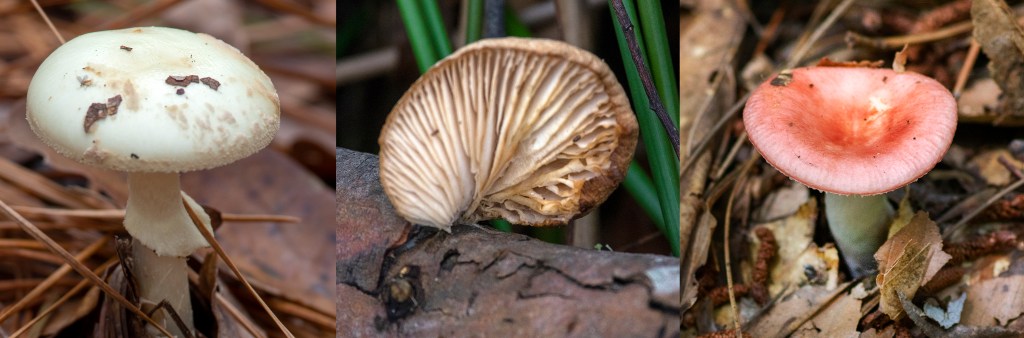
A few from my fungi photo collection. I’m not good at identifying, but I’m pretty sure the one on the left is an Amanita, the one on the right probably a Russula, and the one in the middle perhaps an oyster mushroom.

In the field, we will search, then regroup to identify what we’ve found on a picnic table or whatever likely spot is available. Dr. Sims is bringing a microscope to assist in that process. I encourage all of you to bring your field lupe.

Todd is big on identifying edible mushrooms, so if that appeals to you, bring a basket and/or some mesh bags to collect into. I’m hoping to go home with a few to incorporate into dinner.

We’ll eat lunch at whatever park we are in at the appropriate time while regrouping to identify. Plan accordingly, and although I am not familiar with these locations, I’m guessing we won’t be terribly far from a fast food joint if that’s your preference.

Register at the Certification tab above or let me know you’re coming and pay on site. Suzanne Laird Dartez is coming, so we will have yellow t-shirts to sell for sure.

See you Saturday!

Explore Nature’s Role in Climate Mitigation and Adaptation. Nature For Life Hub Starts Tomorrow, Sept. 24 2020

charlespaxton's avatarWild Open Eye - Natural Vision, News from Wild Open Eye

Nature For Life Hub Starts now, Sept. 24th, 2020 at 09.00 in New York, hosted by UNDP’s Learning For Nature website. Click this link to join the free The Nature for Life Hub – a virtual venue for a four-day program of multiple events “delving deep into specialist topics, practical solutions and ambitious actions” highlighting the role of Nature in climate mitigation and adaptation. It will be held in English, French and Spanish languages.

Watch Climate Mitigation Hub here on Facebook

Hub organizers will work with champions, mobilizers, leaders and speakers who inspire and engage global audiences! These events will provide new content that will be broadcast live on social media and through the official virtual platform, as well as available online after the Hub.

The virtual Hub will be an opportunity to hear from political and corporate leaders, the world’s youth, indigenous and community leaders, local authorities and cutting-edge…

View original post 18 more words

Buggin’ Out!

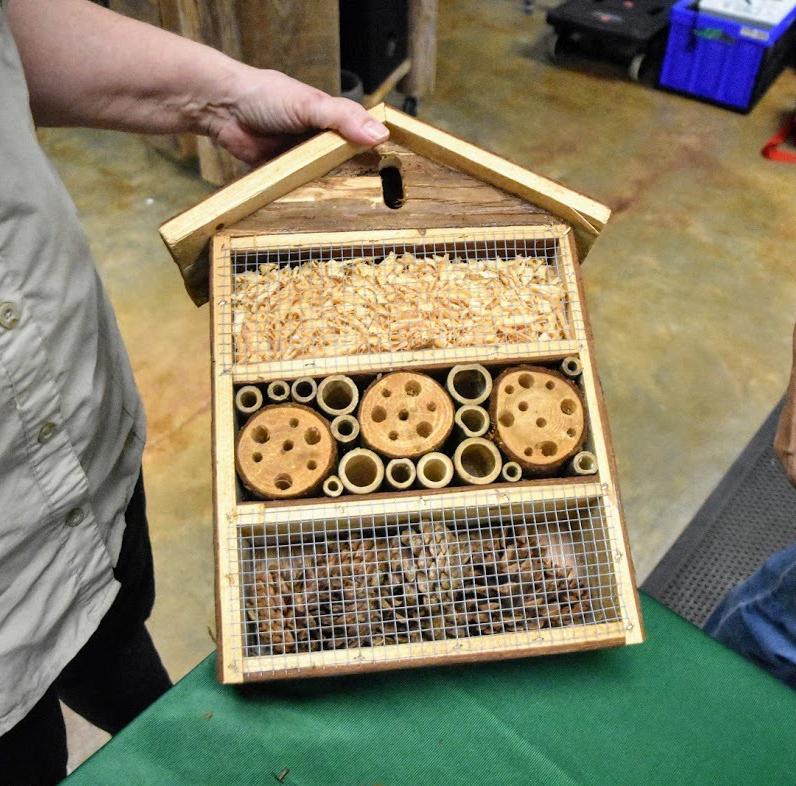
Mason bees (genus Osmia) do not sting! They also don’t make honey, and in spite of their name, they do not drill holes in wood. They occupy already made holes, and they pollinate. Like crazy. So, you want more pollinators for your flowers and vegetable garden? Get or make yourself a mason bee hotel!

A mason bee hotel can be a piece of wood with holes drilled into the end of it or a collection of bamboo tubes stuck into soup can. Be aware that some of the cute ones available online, like the one above, are too shallow. The holes must be at least 5 to 6 inches deep and capped at one end.

This is just one of the tidbits of interesting and valuable information we got from Stacy Blomquist of the U.S. Forest Service at our Saturday workshop. It was a very hot day, so we spent just a short time outside netting and examining bugs, but Stacy’s presentations kept us enthralled. I am deeply grateful to Erin Cox for allowing us to use the Conservation Learning Center for the day, and to Jim, the volunteer who unlocked for us.

Stacy’s presentation of taxonomy was one of the clearest I have heard. We all came away with a better understanding and handouts that provide a framework for us to continue to learn on our own.

The critters we tend to call “bugs” comprise the phylum Arthropoda, in turn comprised of 30-32 orders, of which we learned a bit about 24. The critters that make up all of these orders range from tiny “springtails” of the order Collembola that live in the dirt and are mostly unknown to us, to much more recognizable Lepidoptera–moths and butterflies–which we know and love.

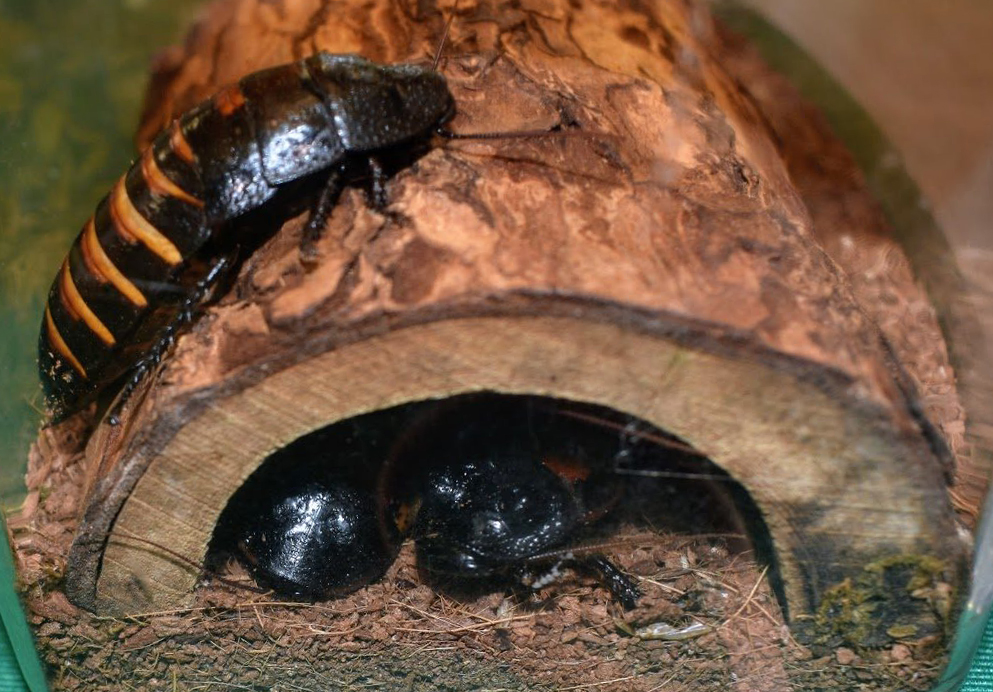
Stacy brought a few exotic specimens with her. These are giant Madagascar hissing cockroaches.

Now here’s what I found most helpful. These scientific names that many of us find so confusing, in fact have meaning. “Lepido” means “scale” and “ptera” means “wing.” Did you know that the beautiful colors and patterns in the wings of moths and butterflies are created by tiny scales of different colors that cover the wings? Hmmm. Makes me think we need a workshop on taxonomic Latin!

In fact, it is challenging and often impossible to get to the species level of identification when dealing with many of the orders of Arthropoda. One reason for that is sheer numbers. For example, the order Orthoptera (ortho=straight, ptera=wing), which includes grasshoppers, crickets and katydids, contains 20,000 species worldwide. Ooops! I can’t image learning that many.

Another reason is that sometimes the differences between critters that determine species identification are too small to see with the naked eye or cannot be seen without dissecting the critter. But we also learned that Arthropoda have open circulatory systems with pumped blood–that is, bugs have a heart! So we really weren’t in the mood to take any apart.

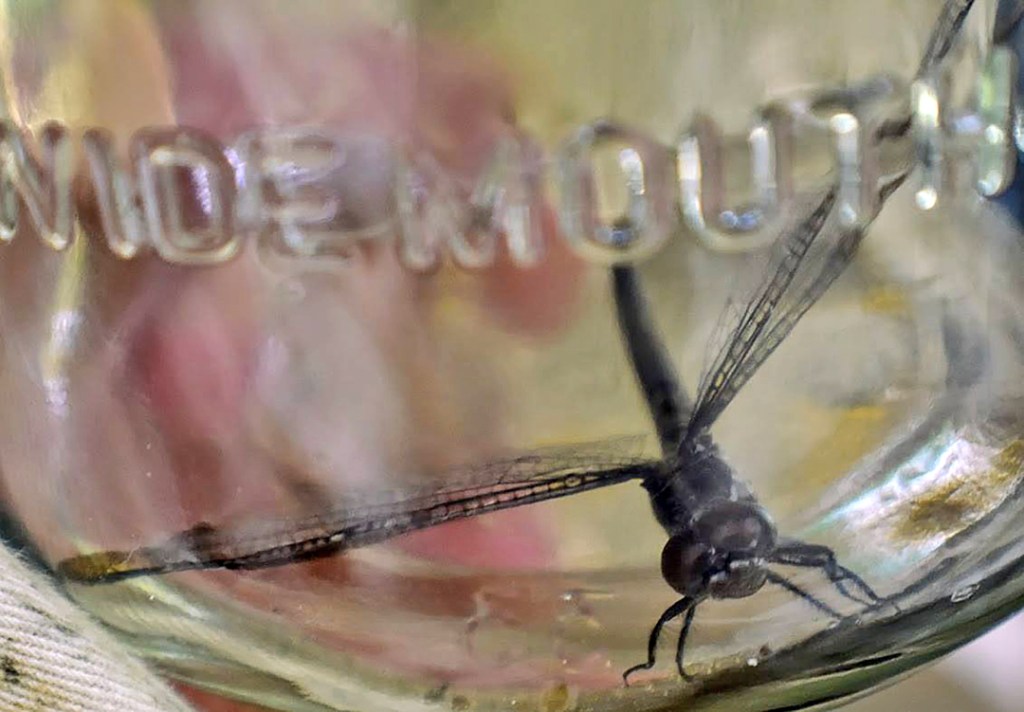
One of our outdoor captures: a male Great Blue Skimmer (Libelulla vibrans). The mason jar does not do him justice, but we kept him only long enough to confirm the identification, and then he flew free again.

As always, so much more could be said about a great workshop. And so will the next one be. Yes, the Oct. 3 fungi workshop is on. I am currently making plans with our instructor Tod Maggio, so stay tuned!