Our LMN-NE Events Committee invites all members to participate in a new nature-focused conversation salon called Wild Talk. It will be a zoom conversation, with focus topics provided along with the emailed zoom invitation.
The first topic is “Winter in Louisiana,” an interesting topic to be sure. The first edition of Wild Talk is scheduled this Thursday, January 13, from 5:30 until 7 p.m. The zoom invitation has already gone out, but if you’re a member and can’t find your email invitation, contact Charles Paxton.
This photo was made January 5, 2016 at Allen Acres in Vernon Parish. Can you identify the plant?
The sessions will begin with a short quiz–no grades issued, it’s strictly for fun! I will not be able to attend this first edition, but I already have some questions in mind that I will submit to Charles.
Participants in the conversation will share outdoor experiences of a seasonal nature, what kinds of wildlife and natural phenomena can be seen and where at this time of year, and so forth. If numbers warrant, the break-out room feature of zoom meetings will be utilized to make it easier for all to share in a small group setting.
The purposes of Wild Talk are to get to know each other better and continue our learning and sharing of information as naturalists. These sessions might well also spawn ideas for actual outdoor excursions.
As personal testimony, I can say that those of us who registered for 2021’s virtual statewide Rendezvous did two sessions like this and had a blast. I highly recommend it.
If you want to submit questions for the opening quiz, send them to Charles Paxton via email <lmnacoms@gmail.com> by Wednesday, January 12, for inclusion in Kimmie Paxton’s Power Point.
So… tell the truth now! Who knew the plant in the photo to be Summer Huckleberry (Vaccinium elliotti)?
For those of you seeking certificate and those of you needing continuing ed credit, our own Dr. Terri Maness will teach us and lead our field work Saturday, January 15, 9 a.m. until about 3 p.m.
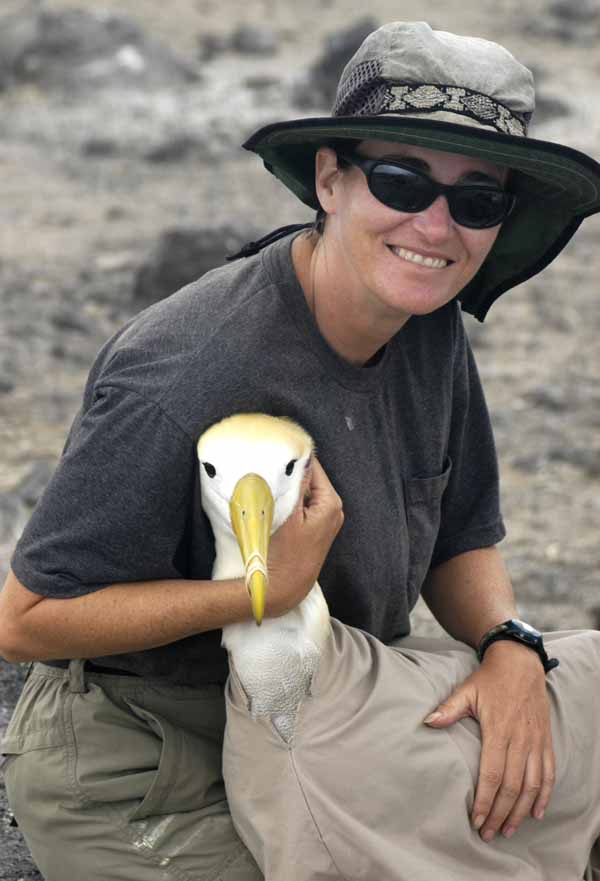
Dr. Terri Maness
Here’s the plan: We’ll convene at the Conservation Learning Center at Black Bayou Lake NWR at 9:00 a.m. (I will be there at 8:30 for anyone who wants to pay on site, but please let me know your intentions.) The cost for this workshop is $25 as usual.
After a short introduction to the field of ornithology, Terri will focus our classroom work on local bird populations and what we can do to help conserve them. We will take a lunch break at about 11:30, then at 12:15, we’ll reconvene in the BBL visitor center parking lot to caravan to the Mollicy Unit for field work.
It will be important to exchange phone #s and travel together because the Mollicy Unit is a bit hard to find. You have to know where you’re going, as the route is not marked. Terri will lead us.
The Ouachita River is visible from the observation tower at the Mollicy Unit. This area is likely to be holding water Saturday the 15th, but we hope not so much water that we can’t get to the tower.
Covid protocols: Physical distancing and masks indoors are required and either double masks or an N95 strongly suggested. Masks outdoors are perfectly acceptable and physical distancing will be maintained. Car pooling from BBL to the Mollicy Unit would be good but masks and no more than two per vehicle is highly recommended.
The link to register for the workshop is live. Click on the Certification tab of this website. A flyer is also available at the flyer link on the same tab.
This workshop is limited to 10 participants due to the necessity of physical distancing inside the learning center. I have already registered, but I had Terri’s workshop before. I’m looking forward to it again, but.. if a person who is not yet certified needs my seat to get into the class, I will turn it over to you and hang out in the refuge while y’all do the classroom work,
Also, if any of our already certified folks and/or experienced birders want to sign up for the field work portion only, let me know. You can pay $10 and join us at the appropriate time.
Finally, if for any reason going to the Mollicy Unit is not practical (flooding, extreme weather, etc.), we will do our field work right there at BBLNWR. Hope to see you there!
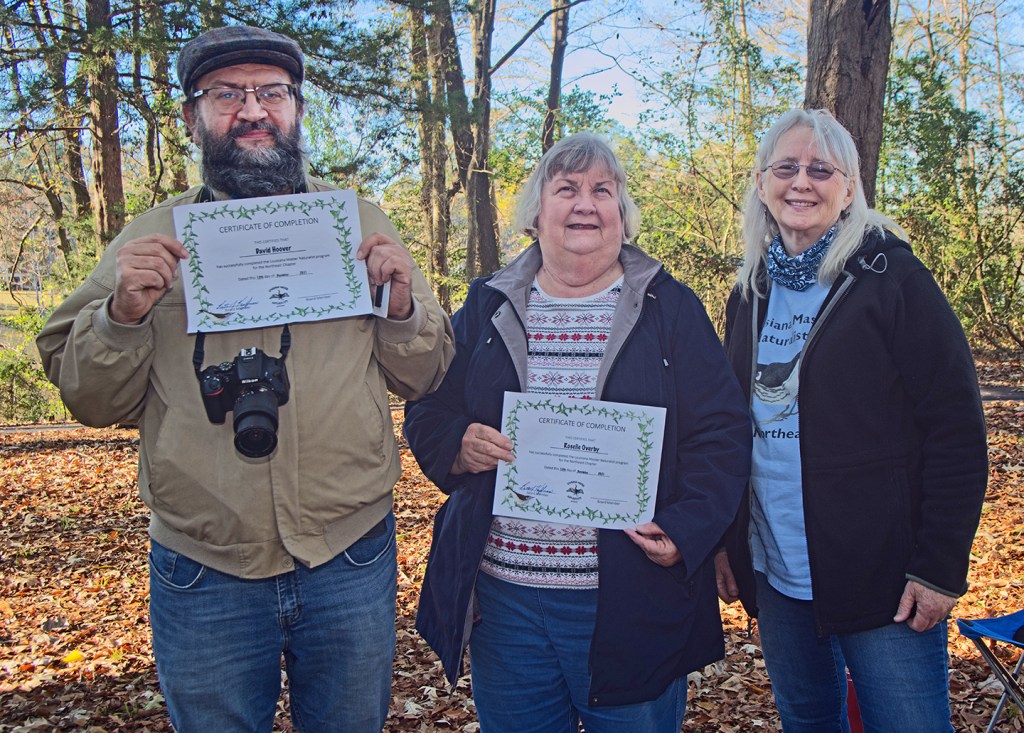
Congratulations to our three newest certified Master Naturalists, David Hoover, Amy Ouchley and Roselie Overby!
From left: David Hoover, Roselie Overby, Amy Ouchley
David’s project was called “Snakes Alive!” and it is a great antidote to people’s fear of snakes. Roselie’s project was an educational hike down the Africa Lake trail in the Tensas River NWR. Amy’s project, “The Joys of Nature Journaling,” was an exhaustive review of the why, how, aesthetics and value added of same for nature lovers at all levels.
Each of these projects has a future as a resource for LMN-NE as we seek to build our chapter and pursue our missions of conservation and education.
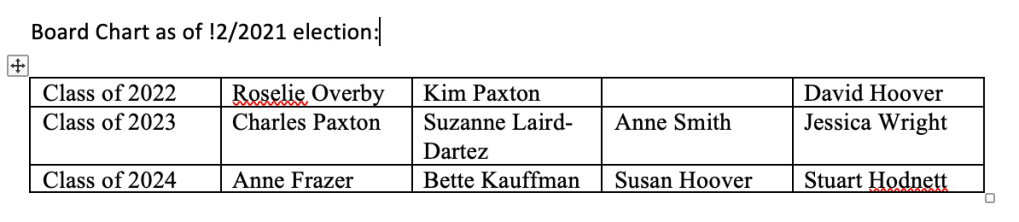
Graduation was followed by a short business meeting. Our most important outcome is a new Board of Directors chart, as follows:
David Hoover was elected Vice President with the understanding that he will move up to president in a year. Susan Hoover agreed to chair a committee to look at ways to make our chapter more diverse and inclusive. Jessica Wright will become our volunteer and continuing ed hours coordinator. Bette Kauffman continues as president, Kim Paxton as secretary, Charles Paxton as treasurer, and Roselie Overby as membership chair.
Kelby Ouchley took advantage of the setting to teach us how to identify an Eastern Cottonwood (Populus deltoides) by its leaf petiole.
Many thanks to Stephanie Herrmann for her term on the Board! And many thanks to the Events Committee, chaired by Charles Paxton, for the work they have done this year.
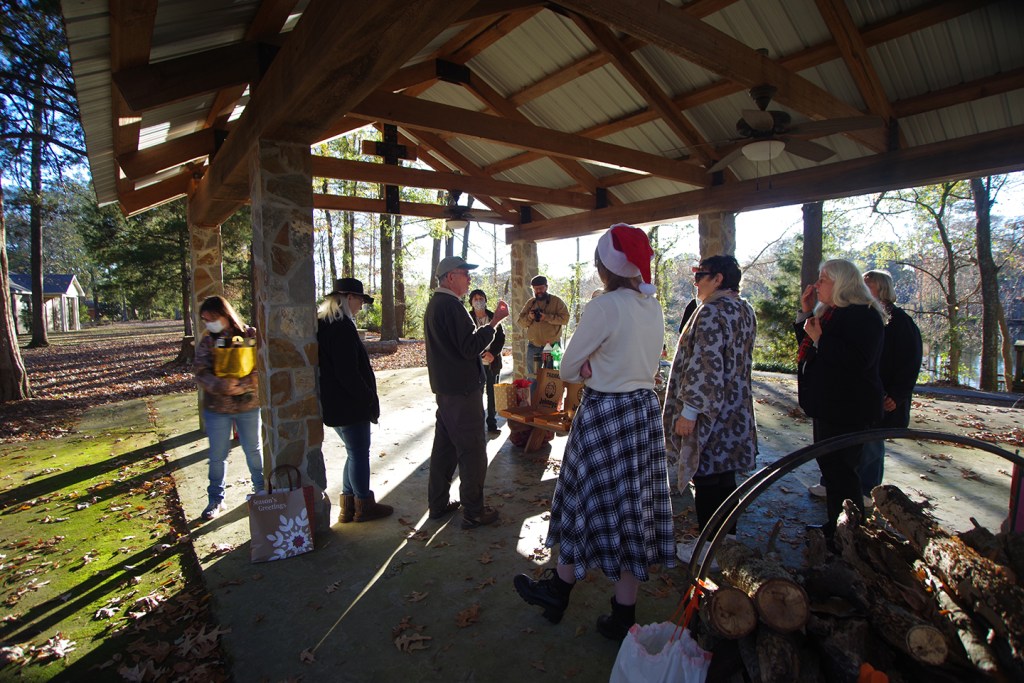
This graduation, meeting and holiday party were conducted in the pavilion at St. Thomas’ Episcopal Church, a beautiful, 2-lot space on Bayou Desiard. Karen Hayward, a member of the church’s Care of Creation Committee, came out to speak with the group. The church already has provided the pavilion, a pier and a paved walking path to the neighborhood, and is interested in involving us in the development of the space as a healthy, natural, educational oasis in the city. You’ll hear more about this!
Chillin’ around the fire with Bayou Desiard in the background.
It was a wonderful occasion. Thanks to all who brought gifts to exchange, food to share and thoughtful participation in planning our future.
We have things to celebrate! Sunday, Dec. 12, 2 – 4 p.m., we will gather to graduate 3 new Master Naturalists, have a quickie 4th Quarter meeting, and celebrate the holidays with food, gifts and fun.
O Christmas Tree!
A new wrinkle: We will gather this year at St. Thomas’ Episcopal Church, 3706 Bon Aire Drive–the church on the bayou. There’s an outdoor pavilion overlooking the bayou and featuring a fireplace and picnic tables. Does anyone have access to firewood? Please let me know.
There’s also a pier (fishing allowed) and a walking path along the bayou. If the weather is suitable, I’m guessing we’ll spend most of our time outside, but we’ll have access to bathrooms and a space indoors equipped with a table, seating, a small frig and a microwave.
Please bring holiday treats to share and a gift in the $15-20 range. Roselie is organizing the gift exchange using a number system, which will end with an opportunity to swap should people choose to.
We’ll begin with graduation, of course. Amy Ouchley, David Hoover, and Roselie Overby will receive their certificates and name tags. I will tell you a bit more about each project as part of the presentation.
After a short 4th Q meeting, we’ll have ample time to enjoy the grounds. You might be interested to know that St. Thomas’ is the only church I know of that has a Care of Creation Committee. I am working with them to enhance their double-lot property on the bayou with plants (mostly native) that will attract birds and pollinators and help stabilize the bayou bank.
Right now, the forecast for Dec. 12 is partly cloudy and 58 degrees. Not bad for mid-December! Hope to see you there.
I had to interrupt Kelby Ouchley to confirm the number. Having been raised in Iowa where farming is huge, I had never heard of a 19,000 acre field. Preposterous! But that’s not the only preposterous fact in the story of the Mollicy Unit.
Here it is, as told to LMN-NE and guests by Kelby and Keith Ouchley, architects of the largest restoration project of its kind in the U.S.
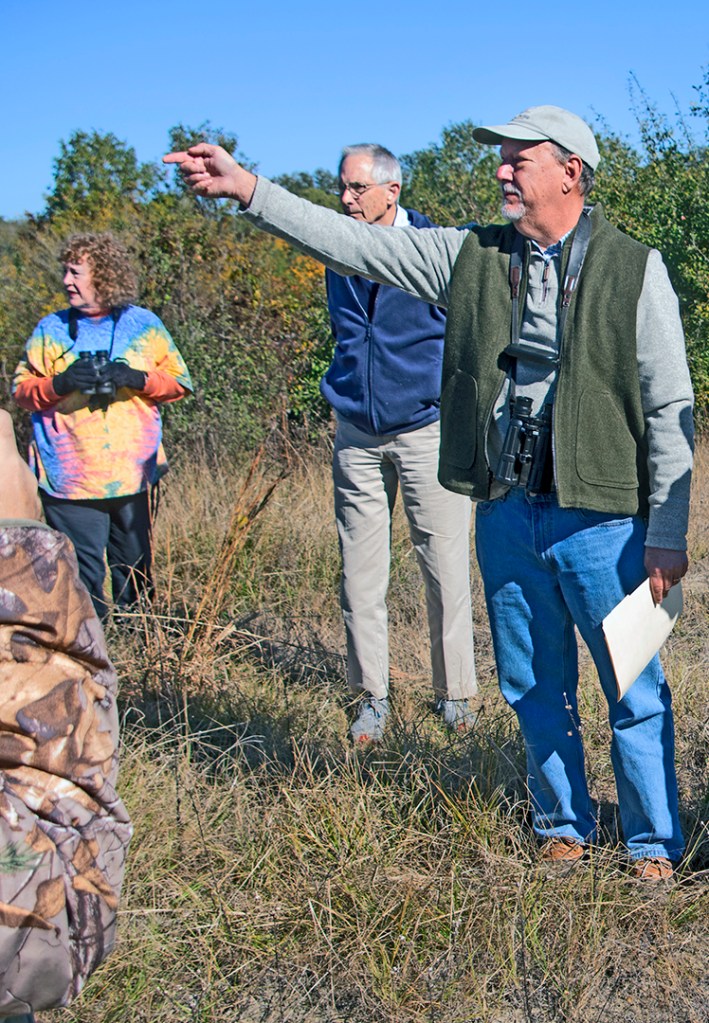
Standing on a levee fragment, Keith Ouchley explains the levee breach and some of the geologic and hydrologic aspects of restoring the flood plain to its natural purpose without further negatively affecting the Ouachita River.
Beginning in 1969, some folks bitten by the soybean craze with BIG dollar signs in their eyes began investing millions and millions in converting a 3×12 mile floodplain (aka swamp) of the Ouachita River into a 19,000 acre field. They built miles and miles of levee to keep out the river, thereby creating a huge basin that filled with water every heavy rain. So they built massive pumps to pump the water–now full of soil and agricultural chemicals–back into the Ouachita River, creating a sediment plume that extended downriver for miles.
Of course, they had begun by bulldozing thousands of trees–bottomland hardwoods–into huge windrows and burning them. And they scraped the entire 19,000 acres as flat as they could, destroying all of the natural plumbing–streams, bayous, sloughs–by moving dirt.
It didn’t work. It was a waste of money and natural resources, especially trees, that killed a prodigious amount of wildlife, polluted the river for years, and threatened everyone downstream–especially Monroe, La., our home–with much greater potential for flooding due to the loss of the floodplain. Preposterous.
Then along came the Ouchley brothers. Kelby was a refuge manager for the U.S. Fish & Wildlife Service. Keith was director of the Louisiana Nature Conservancy. They formed an unstoppable partnership. Twenty years later, all 19,000 acres form the Mollicy Unit of the Upper Ouachita National Wildlife Refuge.
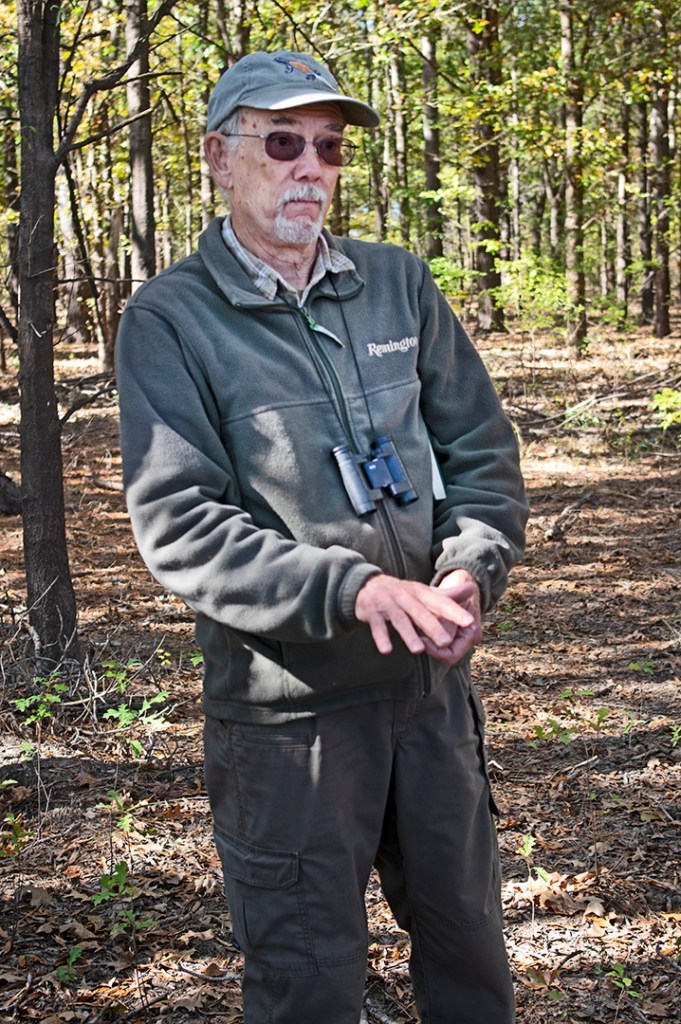
Kelby Ouchley explains that, in Louisiana, one foot of elevation makes a difference in which native trees species were planted in this, the first section of the Mollicy Unit to be reforested.
We stood on this day in 2021 in the shade of bottomland hardwoods–nuttall oak, green ash, and more–that were among the first planted when the restoration effort began. We also visited an observation tower near the north end of the project, from which we could see the Ouachita River meandering by a few miles to the west. Between us and the river, the restored floodplain is dotted with saplings that will survive and thrive with the river’s annual and natural temporary incursions.
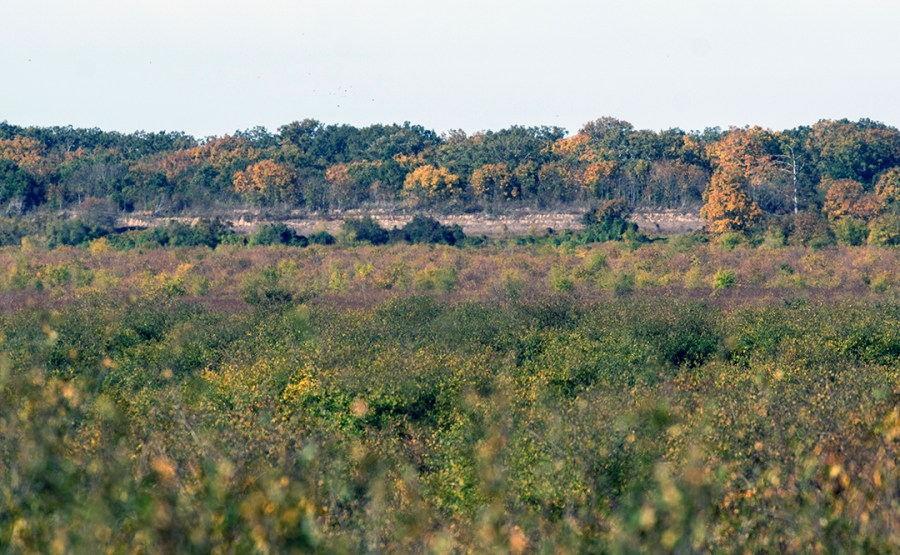
The west bank of the Ouachita River is visible from the observation tower near the east edge of the Mollicy Unit. The area between the tower and the river is flood plain, reforested and dotted again with sloughs that hold water between seasonal floodings.
We stood on a remnant of the levee system and learned about the lengthy planning and careful process of opening five strategically placed half-mile wide breaches that allow the river and the floodplain to give life to each other as they are intended to do.
But this story would not be complete without mentioning that after the restoration process had begun, the river and its floodplain did not wait patiently for human minds and hands to complete the work. In 2009, the Ouachita River was seriously threatening Monroe when it began to overtop the 30-foot Mollicy levee. That night, the river blew a 100-foot hole in the levee and reclaimed its floodplain, putting a halt to reforestation for a time. In Monroe, the river level fell 6 inches in 24 hours.
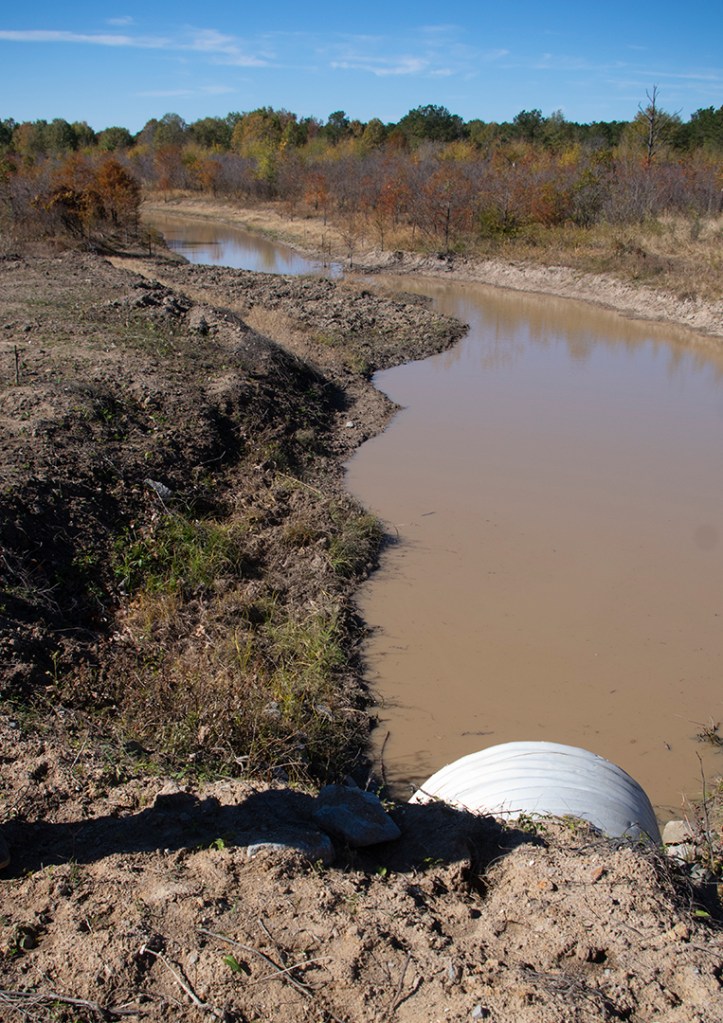
Today, the work continues. The natural plumbing of the area is being restored to the extent possible. Mollicy Bayou was one of those natural features completely filled in and leveled off by the bulldozers. Now it flows again, from the east side of the unit all the way into the Ouachita River on the west, using the exact same footprint, including meanderings and bank slopes, that it had before its desecration.
Mollicy Bayou today, following intense study of its footprint as revealed in aerial photos before it was bulldozed.
Wildlife is returning. We saw tracks and scat. The skilled birder in our ranks recorded 26 birds of 11 species, among them 2 bald eagles. Creation has an amazing capacity for healing when humans stop abusing and offer instead a helping hand.
Who would have thought such a reversal possible? Preposterous.
The Mollicy Unit and the Upper Ouachita NWR are a few miles due north of Monroe and they extend northward to within a few miles of the Arkansas border. The Mollicy Unit is to the east of the Ouachita River, while the bulk of the UONWR lies to the west of the river.
Now is a good time to visit. It is dry, but it will flood again–exactly as it is intended to do. Please be a gracious visitor. Go. Drink in the healing that is happening all around you. Take nothing but peace. Leave nothing but footprints.





 Louisiana Master Naturalists - Northeast